Friday, April 14, 2023

QVMAG QUESTIONS APRIL 2023


PLEASE CLICK ON AN IMAGE TO ENLARGE

If you're defending a lie, you can only defend it with obfuscations 
and other lies. You can't defend a lie with the truth.

Harvey Bialy


Monday, January 9, 2023

BREAKING NEWS CITIZEN VICTORY IN A CARPARK


When one prays one often wonders if the GODS are there and if they're listening. For years now Joe & Mary Citizen in Launceston have been the victims of what might be understood as  Machiavellianism as their representatives at Town Hall twisted and turned to give this or that 'developer' a free kick at their expense. The assumption being that they were elected to make decisions and that many Councillors were there simply to endorse the aspiration of the few. Well that's how it has looked.

Well they must have been listening when one citizen refused to be walked all over to suit the personal aspirations of some at Town Hall and in the days ahead their excesses will no doubt be revealed for all to see.

THAT SAID WHAT HAVE THE GODS DONE! Well the serial and surreal behaviours of the city's LAST COUNCIL have been exposed for what they are. Seriously flawed and entirely inappropriate it seems!  

In a NUTshell their somewhat Machiavellian decision to deny a citizen the opportunity to protect his investment and manage his property as he and his family saw fit and Council's actions have been found to be seriously flawed!.

The way is now clear for Donald G. Allen, Director Carparks Super Pty Ltd to do just that and get on with building his NEW CARPARK at Paterson Street Central. 

Happy New Year Mr Allen!

 The following noteworthy highlighted comments from the tribunal's decision are:   

... The sole reason for refusal by the Council was that the proposal would not comply with clause E6.7.1.3 of the Launceston Interim Planning Scheme 2015, which limits on-site parking within the Central Business District Parking Exemption Area. 

... Notable is that the Tribunal records at 29. The objective of E6.7.1.3 is not to prevent or reduce on-site car parking within the Launceston Central Business District Parking Exemption Area, but rather to limit it. 

... 52. Mr Brook did not undertake an assessment against the criteria in E6.5.1 P1. .– Plainly that approach is wrong. .

... 56.  While Mr Burgess’ evidence was interesting with respect to philosophy of city design, it was of little use in the assessing of the proposal against the standards in the code. 

... 61. Ms Ramm said that Launceston was heavily reliant on car use. .. that 75 per cent of workers in Launceston travel by car and only 2 per cent use public transport. ... there was still a need to provide parking for the majority of people who choose to drive. 

... 63. The Tribunal accepts Ms Ramm’s evidence that during the day on and off-road parking is in short supply in the area of the site. 

...  65. .... given the demand for parking in the area the Tribunal is satisfied that the additional 25 spaces will not exceed that provision [of Table E6.5] The proposal will comply with clauses E6.7.1.3 P1 and E6.5.1 P1.1 and P1.3. .AND 

... 66. accordingly the decision of the Council to refuse a permit should be set aside and the Council directed to grant a permit. .

COMMENT: Don Allen on behalf of Carparks Super Pty Ltd, owners of the Paterson Central Carpark property are as follows: 

Mr Allen said that on behalf of the owner of the property “He was pleased and relieved to receive the full endorsement by TASCAT which has come after years of wrangling with Council since an even-larger multi-storey carpark was approved by Council for our Paterson St site, and over a year since the present application was submitted to Council.” 

He said “ the Company was now free to consider the use and development of its property with freedom and without coercion, and firmly believed their sensible mixed-used development involving retail shops, car parking and residential apartments, was in the best interests of the area, retail traders and the Launceston community at large.” 

He thanked the direct support he has received from the central business community and for the solid advice and assistance from experts who guided the application and subsequent appeal proceedings to a successful conclusion. .

This matter was preceded by lengthy and somewhat expensive actions conducted over the past 3 years and two previously reported legal battles in the Federal Court where the owners successfully won against claims by Creative Property Holdings Pty Ltd and City of Launceston Council (Second Respondents)

Joe & Mary Citizen have every reason to crack a bottle of something as the GODS have given the tribunal exquisite guidance to a citizen seeking what can only be called 'natural justice' despite anything a 'silk' might say.

Arguably the City of Launceston has been delivering less than transparent and accountable governance fo quite a long time. More of this when what we might think of as 'Town Hall carrion' gets to be picked over in coming weeks and months.

WATCH THIS SPACE!

Monday, November 29, 2021

THE BURCHELL'S CARPARK DEBARCLE IN LAUNCESTON TAS

http://tasratepayers.blogspot.com/2021/10/an-ongoing-saga-about-purchase-of.html 


ADDITIONAL LINKS


Decision to turn car park into bus stop to benefit ratepayers Ryan Young
 POTENTIAL SITES: Locations the City of Launceston council considered. Picture: Supplied 

A decision to transform the Paterson Street Central car park into a bus interchange will save ratepayers money in the long run, City of Launceston council chief executive Michael Stretton believes. .................... Mr Stretton said council calculated it would cost about $5 million to $7 million to move the existing major bus stop on St John Street to other on-street locations in the central business district. .................... "My expectation is that we'll be able to deliver it [a new bus interchange on Paterson Street] in concert with the state government for less than what it would have been to have an on-street solution," he said. .................... Labor After 18 months of extensive research and planning, the council recently purchased a share of the Paterson Street Central car park and the old Birchalls building near it for a combined total cost of $14.4 million. .................... The council plans to turn the Birchalls building into an arcade that will house a mix of retail and food businesses. The arcade will double as a thoroughfare which connects the bus interchange and a mooted creative precinct to the Brisbane Street Mall. .................... The council assessed the suitability of 13 potential locations to move the existing bus stop to before it decided to purchase the car park and build the interchange, Mr Stretton said. IMAGE: TRANSFORMING CITY: City of Launceston council chief executive Michael Stretton is excited about taking the next step to give the city's CBD a facelift. Picture: Phillip Biggs .................... "That assessment looked at things like the roadway cross-section, the required operating space, accessibility, the impacts on the bus routing, the impacts on the dead running services and the circulation for the bus networks and impacts on the network operation, other operators, parking and road safety," he explained. .................... The list of potential locations was narrowed down to three sites on Patterson Street, Mr Stretton said. .................... "One was on the street in front of the government offices, one was on the street in front of the church and childcare centre and the other was an actual off-street solution using the Dechaineux Way and the Paterson Street Central car park," he said. .................... "Each of the two on-street options required a lot of modification and design, we costed it at about $5 million to $7 million for either of those spaces. Upon assessment, those sites had too many issues and impacts on the properties that would be immediately behind them." .................... Mr Stretton said the council would now work with the state government to design the interchange. Construction could commence next year.

JULY 29 2021 
Launceston council's Creative Precinct development caught up in legal battle ... Nick Clark .... VISION: An artist's impression of the Launceston Creative Precinct. Picture: Supplied 

The proposed $90 million Creative Precinct development in Launceston is under a cloud as a legal battle over the sale of the Paterson Street Central car park drags on. Owner of the site, Car Parks Super, and a proposed developer of the precinct, Creative Property Holdings (CPH), have been in a legal battle in the Federal Court of Australia since February about a $12 million contract for the sale of the so-called Birchalls car park site. ........................ The vision to put Launceston on the world stage for the best artistic, cultural and creative thinkers was launched more than a year ago. The Creative Precinct was touted as the home to a new creative hub which would include learning spaces, commercial tenancies and retail spaces to link to other parts of the hub, such as the bus mall and Birchalls' retail space being developed by the City of Launceston council. ........................ The proponents, New Creative Group is a consortium of designers, strategists and educators who have banded together to develop the vision for the precinct. ........................ In the Federal Court proceedings Creative Property Holdings, whose director is Chris Billing, has alleged Car Parks Super breached a November 23, 2020 contract. It has sought that the owner be required to transfer the property and is also seeking damages and costs. ........................ Car Parks Super, represented by barrister Shaun McElwaine SC, says that the firm did not make an offer to sell the property that was "capable of acceptance by the purchaser (CPH) and the Launceston City Council and in any event was expressly made subject to the exchange of contracts". ........................ Documents filed in the Federal Court reveal attempts to agree a contract between the two parties in June 2020, September 2020 and November 2020. ........................ A hearing in the Federal Court was due in May this year, but did not go ahead. ........................ Since June 8 Justice David O' Callaghan has made six orders that CPH as the applicant file and serve its written submission, but nothing further has been filed. ........................ If it went ahead the development would have been scheduled to use federal and state government funding of more than $20 million. ........................ The Federal Court documents suggest the City of Launceston council was a guarantor for CPH in two of the proposed car park purchase contracts. ........................ In the proposed June contract the City of Launceston would "guarantee the obligations of the applicant (CPH) and undertook to complete the contract in the event that the applicant breached its obligations to do so". ........................ The council paid a $1.2 million bank cheque, or 10 per cent deposit for the car park on July 9 2020, but the contract was not finalised. ........................ After further negotiations a September 2020 contract was proposed which excluded the council as guarantor. ........................ However, Car Parks Super terminated the contract on October 14 with the company saying CPH had failed to complete by the required date. It claimed the failure meant the deposit was forfeited. ........................ The deposit became a vexed issue between Car Parks Super, CPH and the council and it was not until March 8 2021 that a bank cheque was sent from Car Parks Super lawyers Archer Bushby to Launceston firm Sproal and Associates on behalf of CPH. ........................ Counsel on behalf of CPH, Viridian Lawyers, demanded that the deposit be returned to it or Sproal and Associates on November 13 . ........................ The court filings reveal the council was named as the guarantor for CPH in a proposed third contract dated November 20, 2020 which "provided that the second respondent [council] would complete the contract in the event of default by the applicant". ........................ Email correspondence from council lawyers Simmons Wolfhagen stated that the purported November 2020 offer was "signed by the second respondent (council) in its capacity as guarantor". However, it was not signed by Car Parks Super. ........................ Simmons Wolfhagen wrote to Car Parks Super counsel in December 2020 saying "if exchange does not occur within this time frame then my client's contract will be withdrawn and my client will cease to be guarantor". ........................ The City of Launceston denied to The Examiner that it was ever guarantor for CPH for the car park purchase. The Examiner asked whether the council was ever in a position where it "would as guarantor complete the contract (for the car park) in the event that the purchaser (CPH) defaulted in its obligations"? ........................ "No, the council was never in that position," a spokesman said. IMAGE Launceston Mayor Albert van Zetten. Picture: Paul Scambler ........................ Launceston Mayor Albert van Zetten said "The council has a legal agreement to purchase the site should the CPH development not proceed.https://www.examiner.com.au/story/7341169/citys-90m-plan-caught-up-in-legal-battle/


QUESTION TO COUNCIL WITHOUT NOTICE.

Click on the image to enlarge
CONTEXT

In the past I have challenged Council on the appropriateness of its ‘publication protocols’ and its application of its Intellectual Property (IP) protocols in Council’s operation. Over a number of years I have written to Mayor van Zetten and the GM [AKA CEO] and on each and every occasion, and in various ways the responses to me, in precis, has been ‘everything Council does in this regard is legal’ albeit that in many cases this is highly contestable proposition – and it was when I raised the issue. 


Moreover, there are examples of less than best practice in the context of ‘Council publications’ relative to widely observed ‘acknowledgement protocols’ that lamentedly casts Council in a rather poor light and in many cases would and should be open to legal challenge. In the past, Council has contested the Moral Rights provisions of the Copyright Act and notably in 2018 in regard to Stephen Walker’s Tasmanian Tableau in Civic Square – See for context https://www.examiner.com.au/story/5483771/walkers-tasmanian-tableau-will-be-put-back-home-in-civic-square/ – Council fell well short of its obligations in regard to the ‘Moral Rights’ of an author and was ultimately forced to ‘put right a wrong’. There are other examples of less than best practice in regard to Council’s somewhat cavalier approach to ‘IP matters’  arguably attitudes that reflect poorly on community standards on display in the city.


Additionally, Council is predisposed to use images of people in its marketing and in ways that generally do not acknowledge the photographer/author, the subject/person and concerningly where permission has not been sought to use the image in Council’s marketing etc. This is most concerning when the subject is, albeit subliminally, is presented as a ‘token person/whatever’  token woman, token disabled person, token indigenous person, token obscure ethnicity, etc. etc. However, how might a serving member of Council’s staff deny their ‘employer’ access to imagery of them at work?


This issue I have discussed with Wezley Franckombe who essentially reiterated Council’s past assertions virtually saying (deeming?) that Council’s in-house assessment of its protocols relevant to ‘it’s publications’ finds that they are legal and adequate. Mr Franckombe challenged me to provide him with evidence of Council’s current shortfalls and I randomly selected this years’ QVMAG Annual report where scrutiny reveals:

  • The indigenous peoples acknowledgement appears at the beginning of the QVMAG Manager’s report when current reconciliatory convention generally locates such acknowledgement at the very beginning of such publications as a courtesy; and
  • Photographic images of people, objects, graphics etc. do not anywhere acknowledge the author/photographer and not always the author/maker of an object of ‘cultural production’ photographed; and
  • There is no list of acknowledgements to be found in the report when one would be more than appropriate.


I selected this publication on the grounds that I have IP invested in the QVMAG’s collections and the institution has been the subject of my personal and ongoing research for over 20 years.


Respectfully, I submit that this year’s Annual Report for ‘Council’s operations’, the same might well be said and likewise it can be said of most/all of Council’s marketing material. Compared and contrasted with any other ‘publication’  say newspapers etc, – Council publication’s standards fall well short best practice I suggest. 


Concerningly, it also seems that Council discourages representors et al using/providing evidence in the form of ‘newspaper clippings’ in the context of IP issues. Notably, Australian law sets out a series of clear exceptions to copyright infringement known as "fair dealing". Fair dealing exceptions allow use of copyright material for the purposes of review or criticism, research or study, parody or satire, new reporting, judicial proceedings or legal advice. Thus such advice to representors et al is clearly contestable, and ill founded, as are the standards and protocols Council insists ‘are legal’ and by implication apparently ‘deemed to be’ appropriate in every respect.


Additionally, paraphrased albeit, Mr Franckombe proffered the opinion that legally(?) Council was not required to do more than it does currently. Also, he advised me that he did not know about the existence of the organisation ‘Arts Law … https://www.artslaw.com.au/’, an organisation well placed to offer expert advice to ‘IP OWNERS’, Councils and other organisations etc. on any matter. Alert to this, consequently, Council has access to ‘expert advice’, and as I understand it, Council has an adequate budget allocation in order that it  might seek and gain such advice from any source including Arts Law, Arts Tasmania, – https://www.arts.tas.gov.au/home –  and/or a range of independent specialist ARTSlaw partitioners.


Against this backgrounding I have framed my question to Council as below.


QUESTION


Will Councillors in open council deliberate on and initiate a process whereby Council’s management is commissioned to:

  • Research and review current legal and moral obligations and conventions relative IP issues in the broadest context; and consequent to that
  • In doing so seek the advice and services of experts in the field such as Arts Law, Arts Tasmania, et al; and 
  • Report to Council and Council’s constituency on the IP protocols that operations such as Local Government instrumentalities are morally obliged to initiate and observe towards achieving reconciliatory objectives while embracing current best practice; and
  • Recommend a set of protocols that Council will, going forward, proactively observe and implement; and
  • Clearly set out, and publish, a clear set of ‘policy protocols’ Council will itself observe and expect of those reporting to Council to observe; and
  • Do so by say April 2022.


I look forward with considerable interest to the city’s elected representative’s response.


Ray Norman

<zingHOUSEunlimited>

Sunday, November 28, 2021

ADVICE TO RATEPAYERS WHO WISH TO COMPLAIN ABOUT THEIR COUNCIL

FOR CLIENTS' INFORMATION & CONSIDERATION


Please find attached a letter from Craig Limkin, Director of Local Government, for your attention.


Regards

Margaret Young


Margaret Young  |  Executive Officer

Policy and Intergovernmental Relations Division

Department of Premier and Cabinet

Level 5, 15 Murray Street

Hobart, Tasmania 7000

(p) +61 3 6232 7022  

Margaret.Young@dpac.tas.gov.au  |  www.dpac.tas.gov.au


NOV/DEC QUESTIONS & RESPONSES

CLICK ON AN IMAGE TO ENLARGE


Saturday, October 30, 2021

The Functions of Councillors

Local Government Act 1993 Version current from 1 July 2020 to date (accessed 31 October 2021 at 13:30) 


28. Functions of councillors 

(1) A councillor, in the capacity of an individual councillor, has the following functions: 
(a) to represent the community;.
(b) to act in the best interests of the community;.
(c) to facilitate communication by the council with the community;
(d) to participate in the activities of the council;
(e) to undertake duties and responsibilities as authorised by the council.

(2) The councillors of a council collectively have the following functions:
(a) to develop and monitor the implementation of strategic plans and budgets;
(b) to determine and monitor the application of policies, plans and programs for – 
      (i) the efficient and effective provision of services and facilities; and .
      (ii) the efficient and effective management of assets; and 
      (iii) the fair and equitable treatment of employees of the council;
(c) to facilitate and encourage the planning and development of the municipal area in the best interests of the community; 
(d) to appoint and monitor the performance of the general manager; 
(e) to determine and review the council's resource allocation and expenditure activities; 
(f) to monitor the manner in which services are provided by the council.

(3) In performing any function under this Act or any other Act, a councillor must not – 
(a) direct or attempt to direct an employee of the council in relation to the discharge of the employee's duties; or
(b) perform any function of the mayor without the approval of the mayor

(4) A councillor is to represent accurately the policies and decisions of the council in performing the functions of councillor.

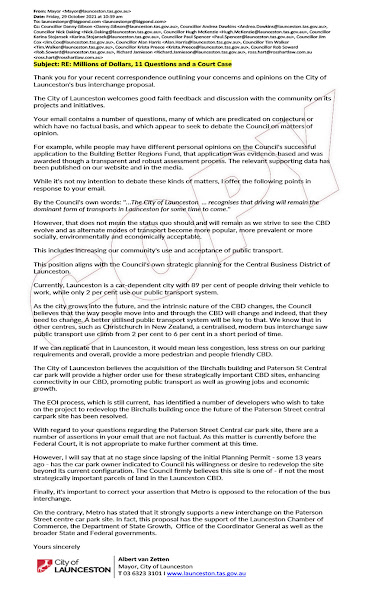
LETTER FROM THE MAYOR

Click above to enlarge

Monday, October 25, 2021

CLIMATE EMERGENCY POLICY: City of Launceston clearly does not know what to do next

IF you follow 'the science' as each day passes you discover that someone somewhere is actually doing something about implementing a policy that requires action and change.

Local governance is front and centre when it comes to the class of 'cultural landscaping' that is required to develop sustainable communities.

In Tasmania, the rhetoric so, so, often flows thick and fast as do the promises relative to being committed to change for the benefit of the planet, future generations, whatever. However, if you look for evidence on the ground beyond the rhetoric you are not likely to find anything of substance.

Yes, yes you'll be pointed to a 'policy decision' but not to an exemplar of its implementation.

Please click on nan image to enlarge


READ AN ABC NEWS ITEM 2019  … CLICK HERE  

WATVH A VIDEO VIA THIS LINK … CLICK HERE 

LISTEN TO THIS ON THE SCIENCE SHOW … CLICK HERE 

Saturday, October 16, 2021

DA 31 Brisbane Street Launceston DA| 0464/2021

CLICK ON AN IMAGE TO ENLARGE

Introduction 

This Development Application (DA) brings into question several aspects of Tasmania’s planning processes and specifically so when its interpretation and implementation is ‘entrusted’ to Local Govt. Typically, a DA is oversighted by a General Manager (GM) who in turn “guarantees in writing” that Councillors/Alderpeople are making ‘determinations’ as a ‘Planning Authority’ upon the advice of people who have the appropriate qualifications and experience to enable them to give such advice to Councillors – those approving or rejecting a DA

Notably, as advised by the Director of Local Govt., the Act is silent on the necessary ‘qualifications and/or experience’ a GM, in compliance with SECTION 65 of the Act must have in order to assert that she/he can in fact make such a “guarantee” with veracity. 

SECTION 65 is quoted below: 
• 65. Qualified persons 
(1) A general manager must ensure that any advice, information or recommendation given to the council or a council committee is given by a person who has the qualifications or experience necessary to give such advice, information or recommendation. 
(2) A council or council committee is not to decide on any matter which requires the advice of a qualified person without considering such advice unless 
(a) the general manager certifies, in writing 
(i) that such advice was obtained; and 
(ii) that the general manager took the advice into account in providing general advice to the council or council committee; and 
(b) a copy of that advice or, if the advice was given orally, a written transcript or summary of that advice is provided to the council or council committee with the general manager's certificate. 

This DA has aspects to it that bring into question a range of considerations beyond ‘stock standard’ developments in the urban cultural landscape that arguably have significant impacts upon the wider community and well beyond the precinct within which it is located. 

Councillors, as ‘community representatives’ will need to consider these issues carefully before granting approval – or indeed denying approval

In the event that Councillors are in anyway unsure of the veracity of the advice they have before them they might well consider ‘leaving the DA on the table' until such time they can be ensured that they have all the appropriate advice.

In this instance, IF Council is disposed to decline approval of the DA what alternative options are open to the proponents to provide the much needed facilities it proposes in the Launceston Municipality? As always there is a multiplicity of choices and the Council along with the proponents might well seek advice from the University of Tasmania's School of Architecture. Within that school there has been an ongoing research program focused upon flexible accommodation for 'young people at risk' that arguably would have application to the issues at hand and potentially direct application if approached with an open mind.

It is not within the scope of this representation to discuss this issue beyond alerting Councillors to UTas Research in the area of concern that is at hand. Council may wish to broker an appropriate development as happens in other jurisdictions. 
For further information please se the links below.

CULTURAL CONSIDERATIONS

This application comes before Council in the context that the building is 'Heritage Listed' and the developer proposes to change its use to one where it accommodates and institution charged with managing young people in a socially distressed circumstances. 

All things being equal the building might well serve such a purpose. However, 'the site' is somewhat problematic in that it lacks conducive outdoor amenity and most specifically any 'green space' on site for unsupervised 'activity'. Given the social cum cultural circumstances and the 'social stressors' the cohort of 'clients' this development aims to serve that is problematic.

It has been asserted that the lack 'space and outdoor amenity' can be overcome and offset given that the building is sited across the road from a generously spaced city parkland. While this may be the case it also poses risks and the potential for unforeseen outcomes. 

One set of risks related to the risks that the 'client cohort' might well be exposed to in such a 'public place' alone and indulging in the kinds of activity they need the 'space' for.

Another set of risks are to do with 'the public' being exposed to, confronted with, this 'client cohort' in a stress filled situation. Such situations are ever likely to present themselves and totally avoidable if the 'facility/institution' provides the necessary amenity on site.

Measuring the risk factors here requires the professional expertise of a social scientist – social welfare professional, anthropologist, cultural geographer. If 'Council planners' have not, or have not been able to access such advice, Councillors in their 'planning authority capacity', arguably would be acting without the advice SECTION 65 sets out to provide them with.

In the end, locating such a facility as one being proposed is one where 'cultural landscaping' become a primary consideration and that aught not be ignored.

ENVIRONMENTAL CONSIDERATIONS

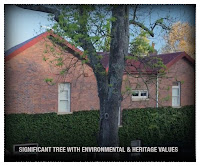
Despite there being no specific reference to the tree on site in the DA, it is there and it is significant from various perspectives. From a heritage perspective it is an important component of the cultural landscape that 'the property' is an important component of. It offers visual amenity to the precinct and thus it needs protection.

Any approval of a development needs to make 'this tree's preservation' a component of approval. While it is claimed that Council in its capacity as a 'Planning Authority' has no power to preserve this tree and moreover it is also claimed that the developer can currently remove the tree without 'Council approval'

As a planning authority Council can place any conditions upon a development it sees fit. Only a recalcitrant developer would wish to challenge that 'authority' and/or appeal it Council's decision outside Council. If it is determined that say the tree is important in respect Council's much touted 'Climate Emergency Policy' Council should be following its own strategic initiative.

In other jurisdictions councils operating as a 'Planning Authority' they place high values on trees and especially so relative to mitigating climate change and visual amenity. The City of Launceston would do well to be seen to be proactive in maintaining, or rather enhancing, the city's urban spaces' vegetative canopy cover. SEE ATTACHED GRAPHIC

In other jurisdictions councils operating as a 'Planning Authority' they have set a percentage of canopy cover that needs to be maintained – typically at least 30%. Launceston's cover is somewhat less than that. Moreover, my advice from Town Hall is that the city's 'Planning Dept.' is disinclined to follow other jurisdictions' 'planning imperatives'.in this regard irrespective of the city's 'Climate Emergency Policy' . SEE ATTACHED GRAPHIC

In other jurisdictions councils operating as a 'Planning Authority' have set a dollar value, and thus a free for the removal of a 'tree'typically between $500 to $2000 plus – with these funds used to plant trees at other sites to offset the carbon cum amenity loss. Again, my advice from Town Hall is that the city's 'Planning Dept.' is disinclined to follow other jurisdictions' 'planning imperatives' in this regard and one officer was quite antithetic to the proposition despite the city's declared 'Climate Emergency Policy'. Given Council's strategic decision relative to the city's 'Climate Emergency Policy' . SEE ATTACHED GRAPHIC

In summary it is quite clear that the city's 'development imperatives' up to now have been careless of, and disinclined to be mindful of, Council's Climate Emergency Policy. Given developments internationally council needs to proactive in implementing its the city 'Climate Emergency Policy'  – no ifs, no buts!

CLICK ON AN IMAGE TO ENLARGE

RAY NORMAN

LAUNCESTON RESIDENT AND RATEPAYER